Design, make, test. Learn faster.
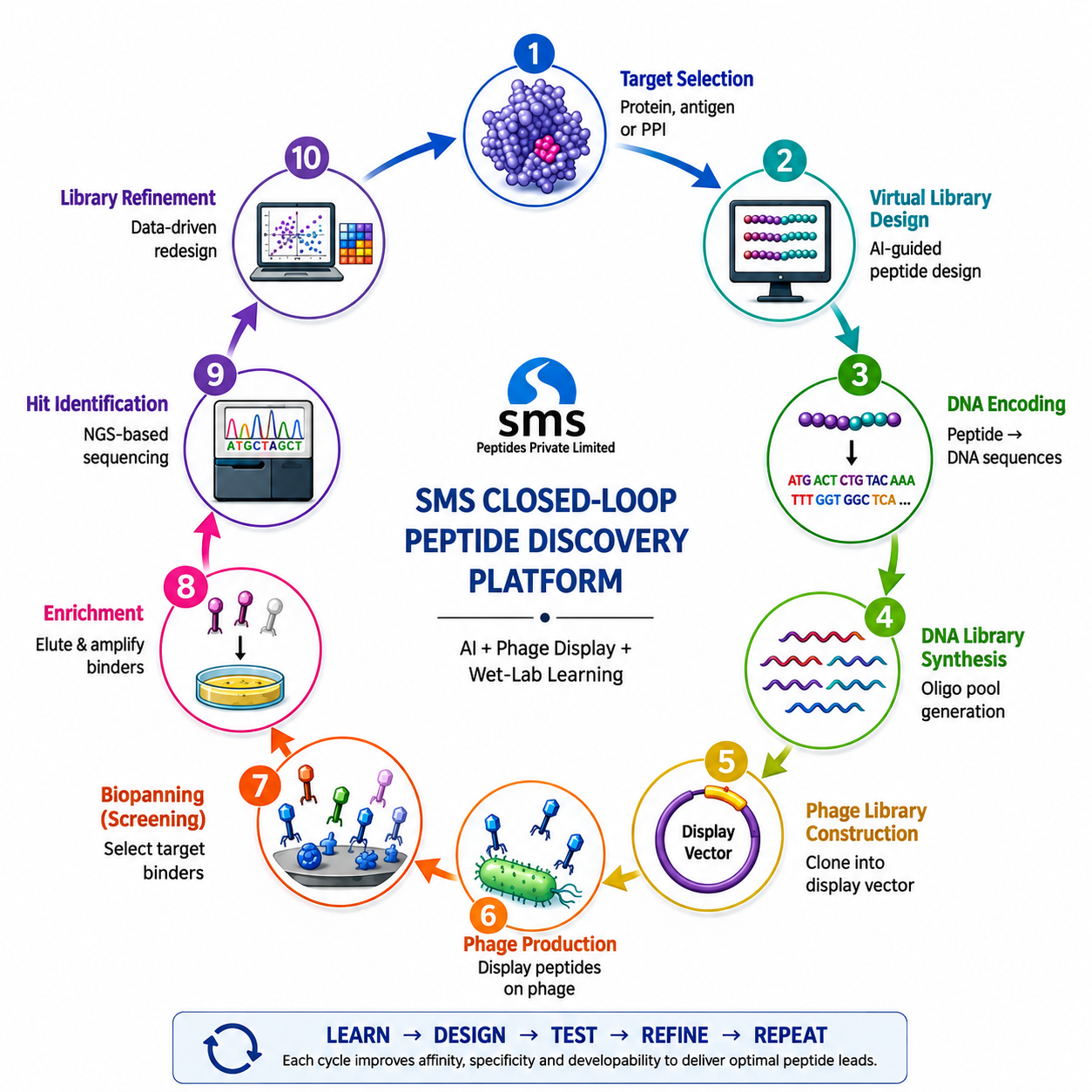
We are building a closed-loop discovery platform where AI-designed libraries meet phage display, and every experiment makes the next library smarter.
Platform in development: enquire about early collaborationsFrom virtual hit to optimised lead.
Each cycle supplies the evidence needed to make the next library more focused and more likely to contain high-quality binders.
AI library design
Computational analysis of the binding site guides AI and machine-learning models to predict high-affinity sequences before wet-lab work begins.
Phage display panning
The enriched library is displayed on phage and taken through three to five rounds of selection. Binders are eluted and amplified.
Hit identification
Enriched clones are sequenced by NGS. Binding is confirmed by ELISA and SPR, and the data is fed back to the model.
Lead optimisation
SAR, alanine scanning, cyclisation and stapling improve potency, selectivity and stability.
Real binding data makes the next cycle smarter.
- 01Confirmed hits teach the model
Binding, sequence and structural data from real hits go back into the AI.
- 02Non-binders matter too
Sequences that fail help the model filter out poor candidates.
- 03Libraries are redesigned
The model builds the next library using both binder and non-binder data.
- 04Each library is more focused
Libraries become progressively enriched for your target.
- 05Hit rates climb
Each round of phage display is designed to deliver a higher hit rate than the last.
A compounding advantage for discovery teams.
Compounding learning
Hit quality improves with every experimental cycle, not just the first.
Grounded in reality
Libraries are built around what actually binds, not only on predictions.
Fewer wasted cycles
Fewer panning rounds can be needed to surface strong candidates.
Best hits rise faster
Promising candidates are prioritised earlier, shortening timelines.
Move from target to validated hit.
Computational design
Use target information and computational analysis to prioritise focused peptide libraries.
Phage display
Apply phage display to identify binders against specific targets.
Hit confirmation
Synthesise and characterise selected sequences to support hit-to-lead decisions.
Program progression
Hand confirmed hits straight to our hit-to-lead and lead optimisation team.
Have a target in mind?
Talk to us about early collaboration on our discovery platform.